Nar Phu Valley Trek
1 465,00 €
This great trek at the foot of the Annapurna takes a little-travelled route to explore the secret valley of Nar and Phu, the Tibetan villages.
For hikers who love preserved and wild spaces, the Nar Phu Valley is one of the trans-Himalayan communication routes to Tibet.
After crossing paddy fields and forests, we rise towards the high mountain area:
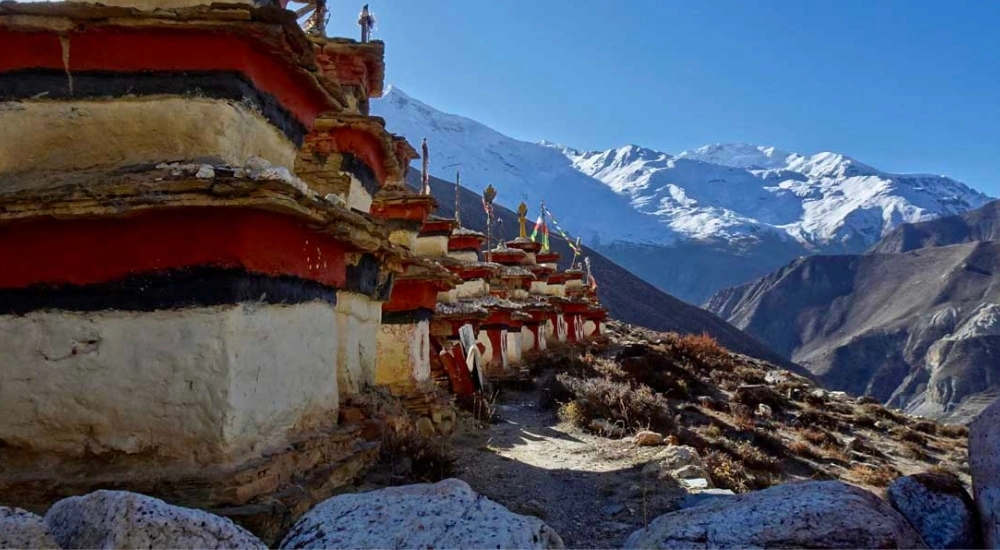
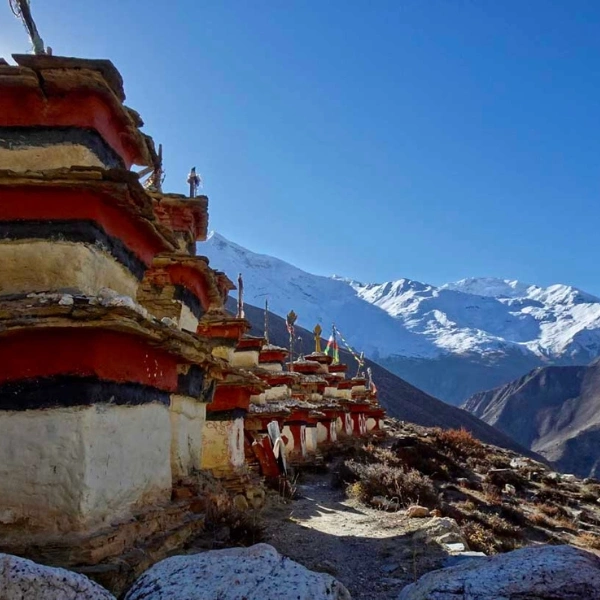
The glaciers are nearby. Arriving at Metha, Chako, Kyang, and Phu, dry stone villages, chortens, and prayer flags fluttering in the wind punctuate a high-altitude desert under Tibetan influence. We leave the Naar valley by crossing the Kanga-La at an altitude of 5322 m. Up there, the Annapurna and Manaslu massifs spread out before our eyes. Then, after quickly cutting through the busy Marsyangdi valley, we will go over the widest high pass in the world, Thorong La at 5416 m, from where we discover the Dhaulagiri and Mustang to the north. This unique immersion at the foot of the giants ends in Jomsom.
- Nepal Country
- Hiking and trekking Thématique
- Difficult Difficulté
- 16 days Duration
- 11 days Hiking days
- 5 416 m Max. altitude
- Yes Guide
- Hôtel, Lodge Hébergement
- Kathmandu Departure / Arrival
- Pokhara – Kathmandu Domestic flights
Scheduled departures
- 11 Apr. 26 Apr. 2027 Planned 1 465 € per person
- 25 Apr. 10 May 2027 Planned 1 465 € per person
- 6 Jun. 21 Jun. 2027 Planned 1 465 € per person
- 18 Jul. 2 Aug. 2027 Planned 1 465 € per person
- 15 Aug. 30 Aug. 2027 Planned 1 465 € per person
- 12 Sep. 27 Sep. 2027 Planned 1 465 € per person
- 10 Oct. 25 Oct. 2027 Planned 1 465 € per person
- 17 Oct. 1 Nov. 2027 Planned 1 465 € per person
Itinerary
Welcome and transfer to the hotel from the airport.
We leave early in the morning in a private vehicle for the village of Besisahar (950 m), where we meet our porters and trekking team. From there, we continue together by local jeep to Dharapani (1,960 m). It’s a long but scenic journey that takes us deeper into the mountains and sets the tone for the trek ahead.
Total driving time: around 9 hours
After about one hour of walking, we reach Bagarchap, with beautiful views of Annapurna II, then continue on toward Danaque, where the Manaslu massif comes into view. We then leave the Marshyangdi River and begin a steady one-hour climb toward Upper Timang. The trail passes through a rhododendron forest (spectacularly in bloom in spring), opening up to stunning views of the Himalayas and the valley below. From there, the walk becomes easier as we head toward Thanchok, crossing a pine forest before reaching Koto, a small Gurung village nestled along the banks of the Marshyangdi River.
From Koto, we enter the high Naar and Phu valleys, which have recently been opened to tourism. We cross the Marshyangdi River via a suspension bridge and follow the Naar Phu River along its right bank. The trail is carved into the cliffs, taking us over scree slopes and through pine forests. After about 2 hours of walking, we cross another suspension bridge and continue on the left bank through more pines before crossing the river again on a wooden bridge. The gorge narrows between cliffs as we make our way toward Dharmasala, offering stunning views of Lamjung Himal (6,932 m). After roughly an hour, we cross a small stream and climb about 300 m steeply (around 45 minutes) to reach Metha, the first dry-stone village in this beautiful valley. The views of Annapurna II (7,937 m) and Lamjung (6,932 m) are breathtaking.
Vegetation becomes sparser, dotted with wildflowers, junipers, and birch trees whose bark was once used as paper for religious texts. The Khampa warriors, originally from Kham in eastern Tibet, settled in Metha after the Chinese invasion of Tibet in 1959, until the Nepali military intervened in 1975. Locals from Naar and Phu descend to this village during winter. We follow the trail ascending towards Phu, along the Phu River. After about 1.5 hours on a relatively flat balcony trail, we reach Jhunum (3,640 m). Along the way, we pass sheepfolds and enjoy stunning views of the glaciers. We cross two streams and the village of Chaku (3,750 m), an old Khampa settlement, before continuing along the river trail towards Phu. We then cross the Labse River (“snow leopard” in Tibetan) to reach Kyang, with beautiful views of Pisang Peak (6,091 m), Tilje Peak, Gyaji Kang, Pokharan Himal, and more. Numerous Chortens along the path mark that we are in the Land of Tibet.
We continue the day walking along a trail carved into the rock, following the river. Along the way, we may spot herds of blue sheep (Naur), a favorite prey of the snow leopard. A pleasant climb brings us to the first gate of Phu, passing by a large mani stone and some ruins. After about an hour on gentle terrain and crossing a long suspension bridge, we arrive at the village of Phu through an impressive gate. The village, once a hub for trans-Himalayan trade, sits on a rocky promontory, with houses blending seamlessly into the rock. Spectacular views include Himlung (7,126 m), Kangguru, Pokarkang (6,265 m), and the Annapurna range.
A relaxing day: rest and a visit to the Tashi Lhakang Monastery, located on the opposite slope. Tashi Lhakang is one of the oldest monasteries in the Nepali Himalayas. In the afternoon, we begin the descent to Chaku.
We descend to Phu Khola (3400 m) and cross it via a suspension bridge to start the climb to the village of Naar. The ascent is gradual, and the trail is dotted with chortens and prayer walls. In the afternoon, we take time to explore the village and rest, preparing for the big day ahead.
We start very early in the morning, gradually climbing up to the Kang La Pass base camp. The trail leads us deeper into a rocky, moraine-filled landscape. Enjoy stunning views of Chulu East and West and Pisang Peak. We camp at the foot of Kang La Pass (4400 m). From the pass, there’s a panoramic view of the entire Annapurna range. Later, we descend to the beautiful village of Ngawal.
Along the trail, we overlook the Manang Valley before reaching Manang village. After a short rest, we climb up to Yak Kharka or Lader.
Gradual climb, sometimes steep from Phedi. Free afternoon or stroll.
Early in the morning around 3:30 am climb to reach the Thorong pass then a steep descent to Muktinath. Mustang’s first village and religious sanctuary for Buddhists and Hindus. Visit the small temple of Muktinath. Night in Jarkhot, a sumptuous traditional village.
Climb to a small wild pass then sometimes steep descent to the Bönpo village of Lupra. then we follow the windy bed of the Kali Gandaki to the Thakali town, Jomsom.
Winding drive along the Kali Gandaki Valley, with breathtaking landscapes of cliffs, gorges, and Himalayan villages. Gradual transition into the green hills before arriving in Pokhara. Free day to relax at Lake Side.
Flight Pokhara – Kathmandu (25–30 min): Fly over the lush valleys and Phewa Lake, then enjoy spectacular views of the Himalayan peaks before arriving in Kathmandu.
Dinner: self
Free time in Kathmandu, then transfer to the airport three hours before your return flight.
Practical Info
– Walking times are approximate and may vary based on group pace, photography stops, and rest breaks. Similarly, elevation gains and losses are general estimates rather than precise GPS readings. – For your safety, the guide reserves the right to modify the itinerary based on weather conditions or unforeseen operational circumstances.
What is included
- Airport-hotel transfer, transport to Besisahar in a private vehicle with AC and private local jeep from Besisahar to Dharapani and Jomsom-Pokhara
- Full-board trek in lodges as per itinerary
- 2 nights at the Holy Himalaya Hotel or similar, B&B in Kathmandu
- 1 night at the Batika Hotel or similar, B&B in Pokhara
- English-speaking guide for trekking.
- Porterage of personal belongings for the entire trek (12kg max/person)
- ACAP trekking permit and Narphu special permit (US$100/person)
- Staff insurance
- Guide's flight and porters' transportation
What is not included
- Meals in Kathmandu and Pokhara (excluding breakfast and sightseeing)
- Nepal visa (to be obtained at the airport: US$30 for 15 days, US$50 for 30 days)
- International flight
- Mandatory repatriation, rescue, and search insurance
- Tips, personal expenses and equipment, drinks, sleeping bag, etc.
- Mandatory supplement for Pokhara-Kathmandu flight: 127$
- Supplement per single room for 3 nights in a hotel: 88$
FAQ
This exceptional trek takes you over two legendary Himalayan passes: Kang La (5,322 m) and Thorong La (5,416 m). These high crossings offer spectacular panoramas of Nepal’s most iconic massifs: Annapurna, Dhaulagiri, Manaslu and even the arid lands of Mustang. Climbing these passes means experiencing the rare emotion of standing on the roof of the world, facing a seemingly endless mountain range. The less-visited Kang La marks the transition from the Tibetan isolation of Nar Phu to the main valley, while the better-known Thorong La crowns the journey with a breathtaking 360° view.
The Nar Phu valley trek crosses varied ecosystems and distinct cultures, creating a rich and exotic adventure. From pine and rhododendron forests to windswept arid plateaus, each day reveals a new setting. You pass from the Gurung hamlets of the foothills to Tibetan villages clinging to the mountainside. This contrast between subtropical Nepal and the desert Himalaya makes the route lively, surprising and deeply authentic. Far from the marked trails, this gradual immersion in altitude and Himalayan culture is a true luxury for travellers seeking originality.
Long closed to foreigners, the Nar Phu valley is a cultural and natural sanctuary at the crossroads of worlds. Its villages, Nar and Phu Gaon, bear true witness to an ancestral way of life, between yaks, barley and centuries-old monasteries. Here, Tibetan Buddhism shapes daily life, and every stone house, chorten and prayer flag tells a story. This immersion in the Tibetan Himalaya reveals a preserved culture, worlds away from the tourist areas. Walking in these remote valleys is stepping out of time, into a confidential and deeply spiritual Nepal.

